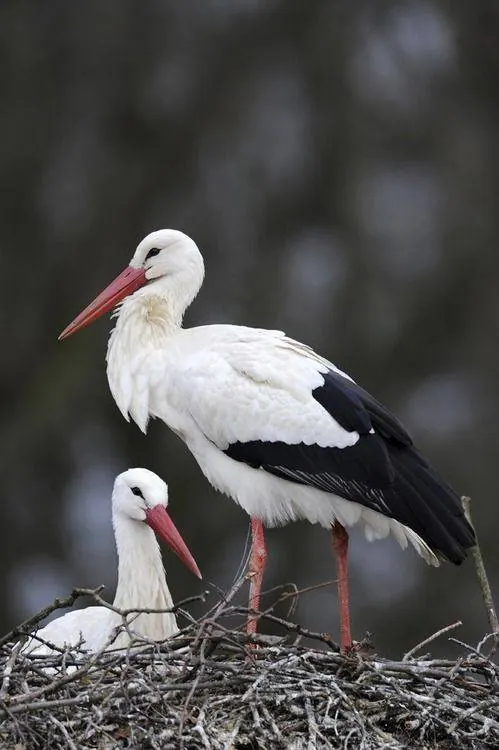
Spring in Ukrainian folk belief doesn’t really arrive until the storks come back — and the stork itself, known regionally as botsiun, boussel or buz’ko, carries far more symbolic weight than a simple sign of the season. The name translates roughly as “God’s Bird,” a reflection of how sacred the image genuinely was, even though the bird itself was treated as anything but distant: storks nested right on people’s houses, and a family a stork chose was believed to be marked for good luck, prosperous enough that people deliberately mounted old cart wheels on rooftops just to encourage a nest to form.
The stork’s symbolism runs in two directions at once. Tied to sky and sun, storks were believed to have first delivered fire to people — which meant harming one risked lightning or an unexplained house fire in return. Tied just as strongly to water, from a diet of frogs and fish caught in rivers and bogs, storks were also connected to rain; in Polissia, killing a snake or frog in imitation of a stork was believed to summon it. Rain itself, in this framework, symbolized the union of heaven and earth — which is part of why rain on a wedding day was traditionally read as a good omen for the marriage.
Perhaps the most striking belief held that storks carried the souls of unborn children, fishing them from rivers, lakes and wells with their long beaks and delivering them into the world — a belief specific enough that some villages baked stork-shaped funeral cookies when a child died. Even the rainbow gets folded into the same symbolic world, sometimes called “veselka” and linked, in various Indo-European traditions, to birds resembling storks carrying it. When the cold sets in, storks are said to travel to “Vyriy” — an old Slavonic name for a body of water understood as the place birds winter, and the place souls wait both before birth and after death.