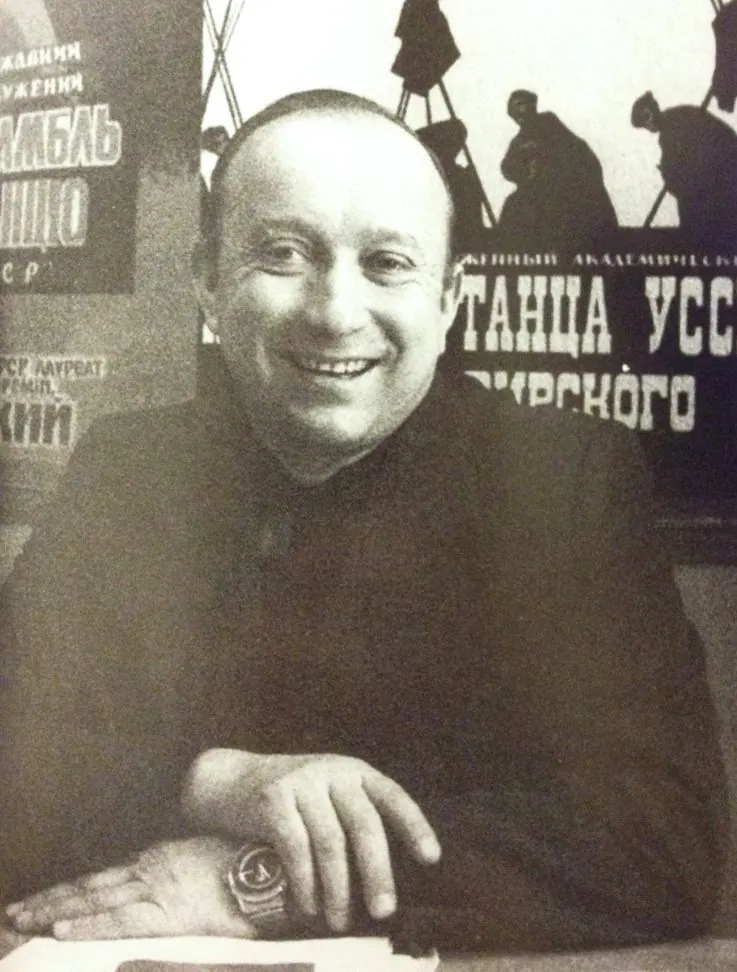

Yaroslaw Chuperchuk was born on September 19, 1911, in Kryvorivnya — a village so steeped in Hutsul tradition it later became the real-world backdrop for Sergei Paradjanov’s “Shadows of Forgotten Ancestors.” It’s easy to imagine that environment shaping him early. In 1927, fresh out of secondary school, Chuperchuk enrolled at the Ternopil Choreographic School under none other than Vasyl Avramenko, who sent him off with a line that became Chuperchuk’s own life motto: “Dance is the language, the mighty language that helps us communicate with the soul.”
His career began on the stage of the Stanislaw Drama Theatre (today’s Ivano-Frankivsk), where his amateur ensemble’s folk dances impressed audiences enough that it felt, by some accounts, like Oleksa Dovbush himself had stepped off the mountaintop to perform. When Ivano-Frankivsk formed its own Hutsul Song and Dance Ensemble in December 1939, Chuperchuk became its first ballet master, creating pieces like “Beyond the Beskydy,” “Hutsulka in the Fields” and “Kolomyjky” while traveling village to village researching authentic folk material — work thorough enough that Pavlo Virsky himself later invited Chuperchuk to create a “Hutsulka” for his own company.
In 1946 he moved to Lviv to choreograph Hutsul dance for a staging of “Oleksa Dovbush,” founding what became the Halychyna Song and Dance Ensemble along the way. Three years later, in 1949, Chuperchuk was arrested on “nationalism” charges and sentenced to eleven years — and even in exile, he formed a Ukrainian song and dance ensemble among his fellow prisoners. A brief release in 1956 brought him to Lviv just as the now-classic stage dance “Holubka” was being developed from movements recorded in the Sniatyn region, and by 1959 he was serving as ballet master, and even playing a small role, in the film production of “Oleksa Dovbush.”
Chuperchuk kept creating with the Halychyna ensemble for the rest of his career — “Chepurnenka,” “Arkan,” “Lisoruby,” “Voloshka” among his best-known pieces — building a body of work that, in western Ukraine, stands alongside Vasyl Verkhovynets’ in influence. He died in 2004, having spent a lifetime bringing Hutsul folk choreography from the mountains he grew up in onto stages far beyond them.