Polissia stretches across Ukraine’s northern border — its name simply meaning “forest land,” from “lis” (ліс) — and it doesn’t stop at any modern border either, continuing into Belarus, the Lublin area of Poland and Russia’s Bryansk region. All of those neighboring cultures have left a real mark on Ukrainian Polissia’s own dance tradition.
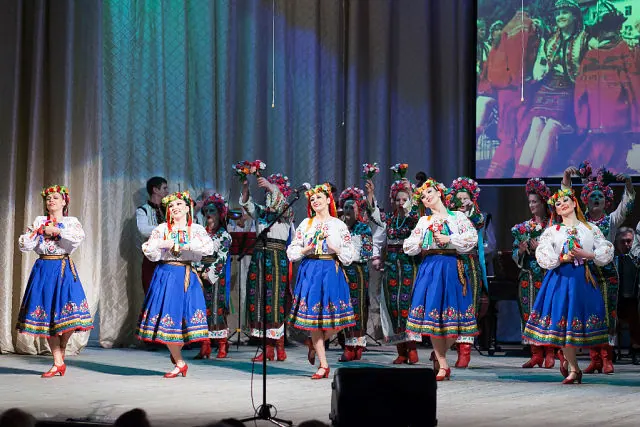
The region’s defining feature, marshland, shows up directly in how the dances move: steps here are elastic, jump-like and soft, performed with a gradual, easy advance rather than sharp attack — a quality shaped as much by regional costume as by landscape, since a wide linen skirt or homespun trousers simply move differently than a tighter cut. Traditional women’s dress paired a wide linen skirt with an embroidered apron and a short vest, topped with either a namitka or a floral vinok for festive occasions; men wore a white linen shirt over matching trousers, belted with twisted rope or leather, with postoly or boots underneath — clothing built for exactly the kind of free, jumping movement Polissian dance is known for.
The region’s own dances — Polka in its many local variations, Kozachok, Hopak, roundelays, and the distinctive waltz-derived “Padespan” — sit alongside genuine cross-cultural borrowings like “Shyr” (also danced as “Shor” in Belarus and “Sher” in Israel, where it began as a Jewish quadrille interpretation tied to wedding tradition) and “Oira,” a polka variant loved across Belarus, Moldova, Russia and Ukraine alike, each region shaping it into something distinctly its own. Modern access to Polissian tradition owes a real debt to folklorists like Rafail Malinowsky, whose “Sonechko” ensemble has hosted Ukrainian Dance Workshop Tour participants eager to learn the region’s dances firsthand.